All categories

War Brides

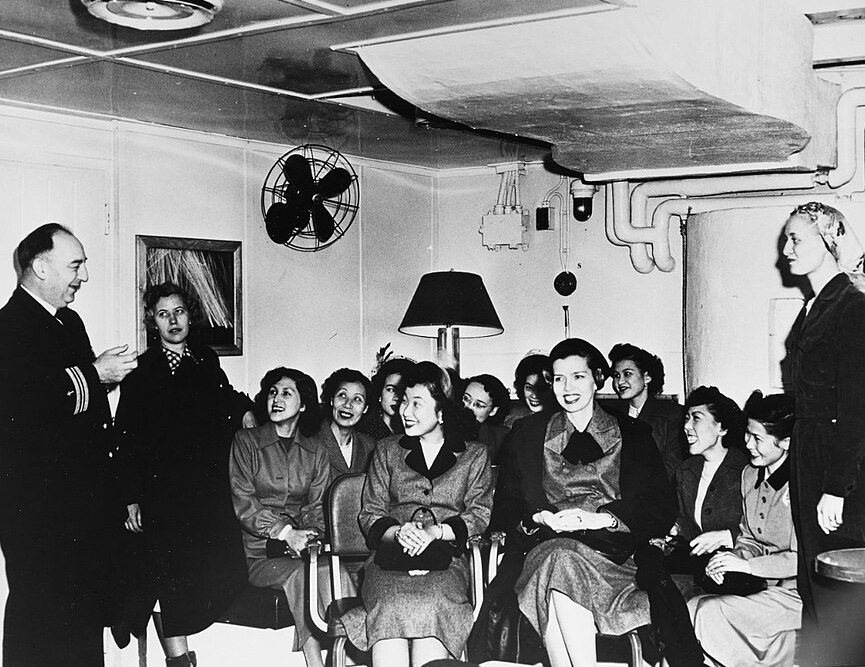
Japanese war brides bound for the United States learn about American customs aboard a U.S. Navy transport, 1951

Japanese war brides bound for the United States are taught about American customs by a Navy chaplain aboard the transport USNS General M. M. Patrick, 19 December 1951.

U.S. Navy photograph. Naval History and Heritage Command, 80-G-438934. Public domain.

More than 100,000 women from Britain, France, Australia, and the other Allied nations, and tens of thousands more from Germany, Japan, and the lands the Americans had occupied, married American servicemen during the war or in the years just after it. The War Brides Act, signed at the end of 1945, let them enter the United States outside the immigration quotas, and the Army carried them across the Atlantic and the Pacific by the shipload. They left behind parents and homes and nearly everything familiar, often for good, and arrived to husbands they had sometimes known only briefly, to in-laws who did not always welcome them, and to a country whose language, weather, and customs they had to learn from the dock onward.
Hiroko Furukawa Tolbert

1929 to unknown

Japanese war bride; arrived in Elmira, New York, in 1952.

Tolbert married American serviceman Bill Tolbert in occupied Japan and emigrated to a poultry farm in upstate New York under the postwar amendments to the War Brides Act. She arrived in 1952 in a borrowed Western dress, a young Japanese woman in a small American town that had so recently been at war with her country, and built a family and a life there over the decades that followed.

Pamela Winfield

1923 to 2013

British war bride; founder of TRACE (Transatlantic Children's Enterprise).

Winfield met her American serviceman husband in wartime England and emigrated to the United States after the war. She founded TRACE, an organization that reconnected British war brides with one another and helped reunite the children some American servicemen had left behind, and spent years helping the women of her generation find each other again.

Flory Jagoda

1923 to 2021

Bosnian-born Jewish war bride; Ladino musician and composer.

Born into a Sephardic family of musicians in Sarajevo, Jagoda fled Bosnia with her parents when the war reached the Balkans and found shelter in a refugee camp in Italy, where she met and married an American soldier, Harry Jagoda. She came to the United States as a war bride in 1946 and spent her life composing and performing the Ladino songs of her childhood, work that earned her a National Heritage Fellowship in 2002.

Pearl Jacobs Daube

born 1924

British war bride; emigrated from Manchester in 1946.

Born in Manchester to Romanian Jewish immigrants, Daube married an American serviceman during the war and sailed for the United States aboard the Queen Mary in the spring of 1946, one of the tens of thousands of British brides who crossed the Atlantic that year to begin again in a country they had never seen.

Researched and written by · Fortitude Research

Work with Erin

Tell me who
you are looking for.

Start the search About Erin