All categories

WASPs (Women Airforce Service Pilots)

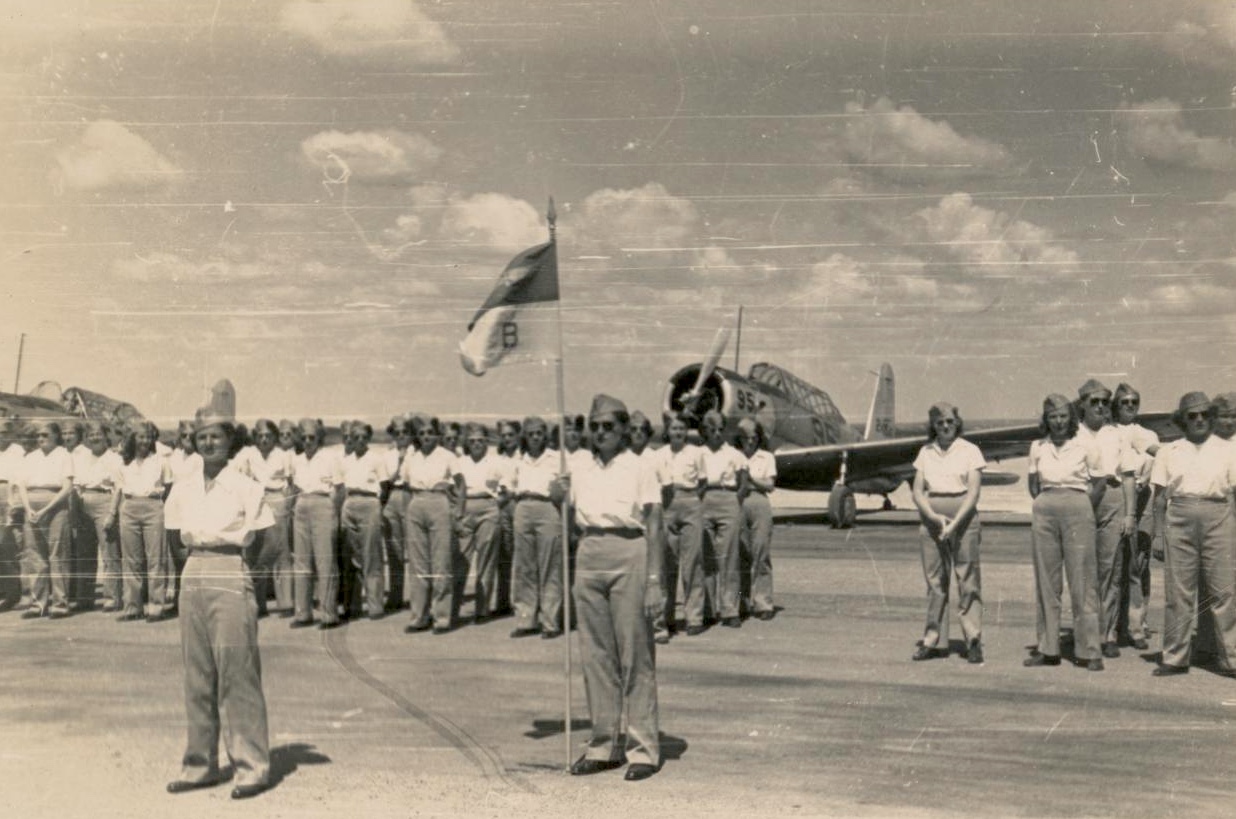
Women Airforce Service Pilots at Avenger Field, Sweetwater, Texas, during WWII training

Women Airforce Service Pilots at Avenger Field, Sweetwater, Texas, during WWII training.

National WASP WWII Museum Collection / The Portal to Texas History.

In 1943, General Henry "Hap" Arnold folded the women's flying programs into one organization under Jacqueline Cochran, and 1,074 American women became Women Airforce Service Pilots. They flew military aircraft across the country: ferrying planes from the factories to the airfields, towing targets so men could practice firing live ammunition, testing repaired aircraft, teaching male pilots to fly. Thirty-eight of them died in service. The country withheld their veteran status until 1977, when President Carter at last signed it into law.
Hazel Ying Lee

1912 to 1944

Pursuit pilot, WASP Class 43-W-4.

Born in Portland, Oregon, to Chinese immigrant parents, Lee earned her pilot's license in October 1932 and flew briefly in China before returning to the United States. She was one of the first Chinese American women to fly for the US military and one of approximately 134 WASPs selected for pursuit training, flying P-39, P-51, and P-63 fighter aircraft on ferrying missions. On 23 November 1944, her P-63 collided with another aircraft on landing at Great Falls, Montana, and she died of her injuries on 25 November 1944, the last WASP to die in service.

Cornelia Clark Fort

1919 to 1943

Ferry pilot, WAFS / WASP.

A Nashville native and Sarah Lawrence graduate, Fort was conducting a civilian training flight over Pearl Harbor on 7 December 1941 when she encountered the incoming Japanese attack force. She joined the WAFS in September 1942 as its second member. On 21 March 1943, her BT-13 was struck by another aircraft in formation near Merkel, Texas, killing her and making her the first American woman pilot to die on active military duty.

Jacqueline Cochran

1906 to 1980

Director, Women Airforce Service Pilots; pioneering American aviator.

Cochran proposed in 1939 to First Lady Eleanor Roosevelt and General Henry "Hap" Arnold that women pilots be used in non-combat military aviation. Arnold named her director of the women's flying training program on 5 July 1943, and the formal merger creating the WASP took effect on 5 August 1943; she oversaw the training and missions of more than 1,000 women pilots. In 1945 she received the Distinguished Service Medal for her wartime command of the WASP.

Nancy Harkness Love

1914 to 1976

Director, Women's Auxiliary Ferrying Squadron (WAFS).

Love earned her pilot's license at sixteen. On 5 September 1942 she was named director of the WAFS at New Castle Army Air Base in Delaware; the squadron went into operation on 10 September 1942 with an initial group of experienced women pilots ferrying military aircraft. After the WAFS merged with Cochran's training detachment in August 1943 to form the WASP, Love commanded the ferrying division of women pilots.

Researched and written by · Fortitude Research

Work with Erin

Tell me who
you are looking for.

Start the search About Erin